
eKash meets Bakong: what Rwanda's link with Cambodia means
On 15 November 2026 the central banks of Rwanda and Cambodia switched on a test link between eKash and Bakong, their national payment systems. People in Cambodia can now send money from Cambodia to Rwanda, straight to a bank account or mobile wallet. Here is what was launched, how a transfer moves, who stands to gain, and what to do now.

The short version
- A test link, live from 15 November. Cambodia's Bakong now connects to Rwanda's eKash.
- One direction for now. Money goes from Cambodia to Rwandan bank accounts and wallets.
- Two small economies, 8,400 km apart. Rwanda's prices are rising fast; Cambodia runs on dollars.
- The timing is no accident. President Kagame's first state visit to Cambodia came two days earlier.
- Five openings, mostly for Rwandan businesses that sell to Cambodia.
- Real limits. Small volumes, currency conversion, unpublished fees, and scams.
- Seven things to do now, none of which cost money.
What did Rwanda and Cambodia launch on 15 November?
On Sunday 15 November 2026 the National Bank of Rwanda (BNR) and the National Bank of Cambodia (NBC) launched what they call the "Proof of Concept of Cross-Border Remittance between the Kingdom of Cambodia and the Republic of Rwanda". They did it in Phnom Penh, at the Black Swan Summit Cambodia, a two-day fintech meeting at the Koh Pich Exhibition and Convention Center.
Their joint press release says the link enables "customers in Cambodia to send money to beneficiaries in Rwanda quickly and securely." It connects Bakong, Cambodia's national payment system, with eKash, Rwanda's national payment system, which R-Switch operates. Two banks carry the money across. ACLEDA Bank Plc is the correspondent bank in Cambodia, and I&M Bank (Rwanda) Plc is the settlement bank in Rwanda.
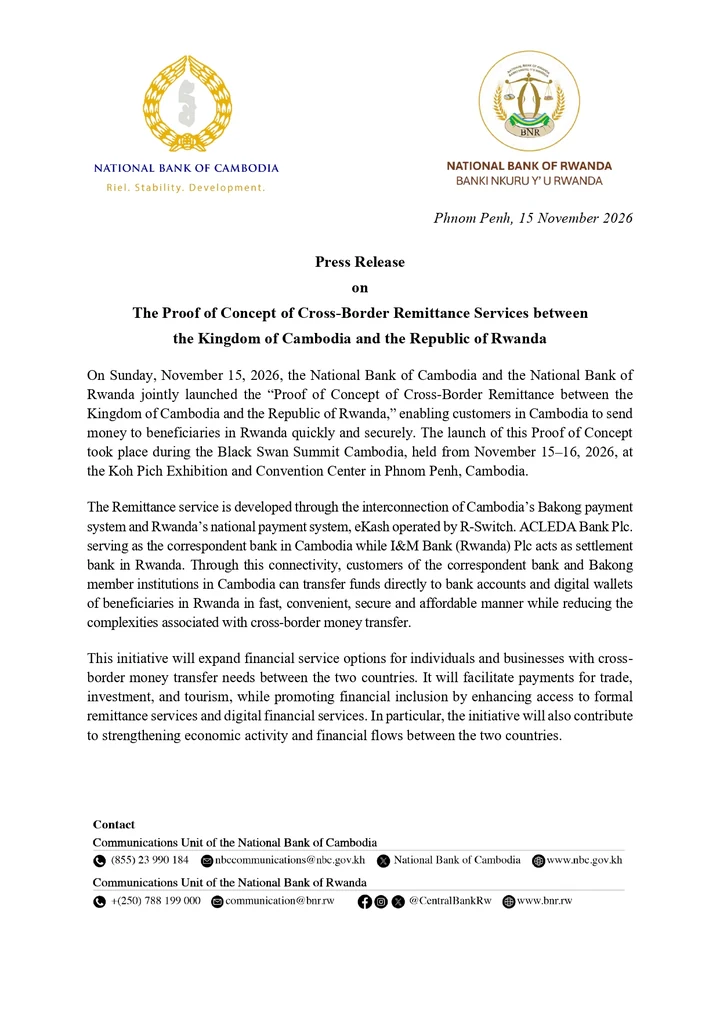
Customers of ACLEDA and of other Bakong member institutions can send to "bank accounts and digital wallets of beneficiaries in Rwanda". In Rwanda, a digital wallet mostly means MoMo or Airtel Money.
A proof of concept is a live test. The money is real, but the purpose is to see whether the connection works and what it costs to run. The NBC's own release says the link is "initially facilitating remittances from Cambodia to Rwanda". Sending from Rwanda to Cambodia is not part of it yet. As at 15 November 2026 neither bank had published fees, limits, the exchange rate or a timetable for a full service.
The groundwork goes back three years. In April 2023 the two central banks signed a cooperation agreement covering payment systems, digital payments and financial inclusion. In May 2026, at a meeting of Francophone central bank governors in Phnom Penh, they announced that they would work together on cross-border payments.
How does a transfer from Cambodia to Rwanda move?
The banks have not published the technical route. From the press release, our reading of a transfer is this:
-
SenderCambodia
A customer of ACLEDA, or of another Bakong member bank or wallet, starts a transfer to someone in Rwanda.
-
BakongCambodia
Cambodia's national system carries the payment to ACLEDA, the correspondent bank that holds the Cambodian end of the link.
-
The linkPhnom Penh to Kigali
The payment crosses between the two national systems. Somewhere here, riel or US dollars become Rwandan francs.
-
eKashRwanda
R-Switch's eKash receives it, and I&M Bank Rwanda settles the money on the Rwandan side.
-
RecipientRwanda
The money lands in a Rwandan bank account or mobile wallet that is reachable through eKash.
That is shorter than the usual route. Money sent from Phnom Penh to Kigali today normally travels through international correspondent banks, often by way of US dollars at a bank in a third country. Each bank in the chain takes a fee and some time. Linking two national systems removes some of those steps. Whether it also removes cost is exactly what the test has to show.
The Rwandan side is already busy. Since 14 July 2026, under a BNR directive, every transfer between different banks and mobile money wallets in Rwanda has gone through eKash. The fee for such a transfer is capped at RWF 20, and a single transfer can be up to RWF 10 million. Bakong, live since October 2020, is larger still.
Rwanda and Cambodia at a glance
The two countries are about 8,400 km apart in a straight line, and Phnom Penh is five hours ahead of Kigali. There is no direct flight. Rwanda is a small, landlocked country in East Africa. Cambodia sits on the Gulf of Thailand in Southeast Asia, between Thailand, Laos and Vietnam, and is almost seven times Rwanda's size.
| Rwanda | Cambodia | |
|---|---|---|
| Population | 14.4 million (2026) | 17.3 million (2024) |
| Land area | 26,338 km² | 181,035 km² |
| Capital | Kigali | Phnom Penh |
| GDP | US$16.4 billion (2025) | US$50.7 billion (2025) |
| Growth | 9.4% in 2025, 7.4% forecast for 2026 | 5.3% in 2025, 3.0% forecast for 2026 |
| Currency | Rwandan franc (RWF) | Riel (KHR), with wide use of US dollars |
| Rate to US$1 | RWF 1,477 (13 Nov 2026) | KHR 4,073 (13 Nov 2026) |
| Inflation | 19.5% a year, urban (Oct 2026) | 5.9% a year, Phnom Penh (Oct 2026) |
| Internet users | 4.74 million, 31.7% (Oct 2026) | 12.4 million, 68.5% (Oct 2026) |
| Mobile connections | 13.6 million (late 2026) | 21.0 million (late 2026) |
| Remittances received | US$640 million (2025) | US$2.1 billion (2025) |
| National payment system | eKash (R-Switch) | Bakong (NBC) |
| Time zone | UTC+2 | UTC+7 |
Two differences matter for anyone sending or receiving on this link. Cambodia runs largely on US dollars: at the end of 2025, 90.7% of bank deposits were in foreign currency, according to the NBC. The riel is gaining ground on Bakong, though, where it carried 58% of transactions in 2025.
Rwanda has the opposite worry. Prices are rising fast. Urban inflation reached 19.5% in the year to October 2026, up from 7.1% a year earlier, and BNR has raised its central bank rate three times this year, to 8.75% in August. Money that arrives in francs loses buying power quickly, so a business paid from Cambodia should think about when it is paid and in which currency it prices.
How close are Rwanda and Cambodia?
Closer this month than ever before. The two countries established diplomatic relations in 2005. Rwanda's ambassador to Cambodia is based in Seoul and presented credentials in Phnom Penh in March 2024, when he also met Rwandans living there. In November 2025 Cambodia's Deputy Prime Minister and Foreign Minister, Prak Sokhonn, visited Kigali, and the two sides signed an agreement on regular consultations and a visa waiver for diplomats and officials.
On 13 November 2026 President Paul Kagame held talks in Phnom Penh on his first state visit to Cambodia, in the week of the 20th Francophonie Summit there. Both countries belong to the Francophonie. After talks with Prime Minister Hun Manet, the two leaders oversaw the exchange of three documents: an investment agreement between the Council for the Development of Cambodia and the Rwanda Development Board, a memorandum on tourism, and an Air Services Agreement, the legal basis airlines need before they can fly between the two countries.
Two days later the payment link went live. Investment, tourism, flights and money transfers, all in one week, read like a plan.
Trade, though, is tiny. Rwanda's exports to Cambodia were worth about US$2.8 million in 2025, almost all of it ores, and its imports from Cambodia about US$27,000, according to UN Comtrade data published by Trading Economics. That is the honest starting point for any business case.
Why connect two payment systems 8,400 km apart?
Sending money across borders is still expensive. World Bank figures for the third quarter of 2025 put the average cost of sending US$200 at 6.36% worldwide, 8.46% to sub-Saharan Africa and 10.73% to Rwanda. The United Nations target is below 3% by 2030. On a US$200 transfer to Rwanda, that gap is worth about US$15.
The flows are real. Rwanda received US$640 million in remittances in 2025, up from US$502 million in 2024, according to BNR. Cambodia received US$2.1 billion, more than three quarters of it from Thailand.
Bakong has been linking up with its neighbours for years. It has QR or transfer links with Thailand, Laos, Vietnam, South Korea, Malaysia and Singapore, and with China's UnionPay and Japan's QR system. We found no earlier Bakong link with an African country. In her remarks this week, NBC Governor Chea Serey spoke of connecting with Francophone African payment systems for "remittances and small-value trade".
Rwanda is building outwards too. In November 2025 R-Switch and Tanzania's central bank began technical work on a proof of concept linking eKash with Tanzania's instant payment system.
Our view: the money that moves on this link in its first year will be small. The value is in the plumbing. A working connection between an Asian and an African national payment system, built by the two central banks, is a template other countries can copy. If it works, Kigali sits at one end of it.
There is a quieter point too. Both central banks chose to run their own national payment systems rather than leave everyday payments to foreign card networks and correspondent banks. In Kinyarwanda the word for that instinct is agaciro, self-worth, the refusal to depend on others for what you can do yourself. A link between two such systems is two countries choosing to deal with each other directly.
Five business opportunities the link could open
Because money flows from Cambodia to Rwanda, the first openings favour Rwandan businesses that get paid by Cambodian customers. These are possibilities, not promises.
1. Exporters paid by Cambodian buyers
A coffee roaster, tea estate, flower farm or craft cooperative in Rwanda that finds a buyer in Cambodia has, until now, faced slow and costly international payments on small orders. A direct route to a Rwandan account makes a first trial order easier to agree. It will not replace trade finance for large shipments.
2. Tourism, travel and events
The tourism memorandum and the air services agreement point the same way. Tour operators, hotels and conference organisers in Kigali, Musanze and Rubavu could take deposits from Cambodian travellers and delegations without asking them to arrange a wire transfer.
3. Services sold over the internet
Software development, design, accounting, translation, customer support and online teaching can all be sold to a client in Phnom Penh from an office in Kimironko. Both countries are in the Francophonie, so French and English services both have a market. Getting paid has often been the hardest part of selling services abroad.
4. Payments and integration work
Every new payment channel creates technical work: connecting banking apps, matching incoming payments to invoices, screening transfers for compliance, and keeping records that satisfy auditors. Rwandan developers and IT firms that understand eKash will be well placed as more links follow.
5. Investment and trade services
The agreement between the Council for the Development of Cambodia and RDB is meant to bring investors in both directions. Lawyers, accountants, consultants and property firms that help foreign investors set up in Rwanda gain a new source market. When the link runs both ways, Rwandan importers could also pay Cambodian suppliers directly.
Who gains, and who does not yet?
Families in Rwanda who receive money from relatives working or studying in Cambodia gain first. Rwandan businesses paid from Cambodia gain as described above.
ACLEDA and I&M Bank Rwanda get the first mover's place in a new corridor. R-Switch gains a live link to Asia for eKash. The two central banks learn how to run such a link before volumes grow.
Not yet: anyone in Rwanda who needs to pay someone in Cambodia, since the link runs one way. Also anyone in Cambodia whose bank is not taking part yet, and anyone in Rwanda without a bank account or mobile wallet.
What are the challenges and risks?
Small volumes. With trade under US$3 million a year, the link has to prove it is worth running. A proof of concept can be changed, paused or stopped.
Currency conversion. Much of Cambodia's money is in US dollars, and Rwandans are paid in francs. Who sets the exchange rate, and what margin sits inside it, has not been published. The franc has lost about 1.8% against the dollar over the past year, and prices in Rwanda are rising fast.
Unpublished fees and limits. Until the banks publish them, compare the amount that arrives in francs with what a money transfer company would deliver.
Scams. Instant payments are hard to reverse, and every new channel attracts fraud. Expect messages about "wrong transfers" that ask for refunds, and fake investment offers.
Compliance checks. Cross-border payments are screened for money laundering and sanctions. A name that does not match the account exactly can delay or stop a transfer.
Teething problems. New systems have them. In October BNR moved to deal with delayed eKash transfers at home. Add a second country, and delays are possible.
What to expect next
This part is our expectation, not an announcement. The test will be reviewed, and more Cambodian banks and wallets are likely to join if it works. A route from Rwanda to Cambodia is the obvious next step. Bakong already lets travellers pay by QR code in some partner countries, so QR payments for Cambodian visitors in Rwanda, and the reverse, are plausible later. Flights will need an airline to see demand, which the new agreement allows but does not create.
Watch for three things: the published fee and exchange rate, the list of participating institutions, and any date for two-way transfers.
How to get your business ready
- Make sure you can receive. Use a business bank account or wallet reachable through eKash, registered in exactly the name you give customers.
- Ask your bank three questions: can it receive transfers from Cambodia under the pilot, in which currency, and at what rate and fee. Write the answers down.
- Put full payment details on every invoice: account name, number and bank, and who pays the transfer costs.
- Price with the exchange rate in mind. Agree in writing whether the customer pays in US dollars or Rwandan francs.
- Record foreign receipts properly: the amount in francs, the rate on the day, and any difference. Your accountant will need it.
- Make one rule for unexpected money: never refund to a different account, and confirm by phone on a number you already have.
- Look after customer data. Under Law N° 058/2021, holding customers' personal data means registering with the National Cyber Security Authority.
None of this costs money. Most of it is one conversation with your bank and one with your accountant.
Frequently asked questions
Can I send money from Cambodia to Rwanda with Bakong?
Under the proof of concept launched on 15 November 2026, customers of ACLEDA Bank and other Bakong member institutions in Cambodia can send money to bank accounts and digital wallets in Rwanda through eKash. Ask your bank in Cambodia whether it offers the service yet, and what it charges.
Can I send money from Rwanda to Cambodia through eKash?
Not yet. The National Bank of Cambodia says the link initially covers remittances from Cambodia to Rwanda. Nothing has been announced about the other direction.
What is eKash?
eKash is Rwanda's national instant payment system, operated by R-Switch. Since 14 July 2026 it has carried transfers between different banks and mobile money wallets in Rwanda, with the fee capped at RWF 20 per transfer and a limit of RWF 10 million per transaction.
What is Bakong?
Bakong is Cambodia's national payment system, run by the National Bank of Cambodia since October 2020. It works in riel and US dollars and uses the KHQR code. The National Bank of Cambodia reports about 38 million accounts.
How much does a transfer from Cambodia to Rwanda cost on the new link?
Fees, limits and exchange rates had not been published as at 15 November 2026. Ask the sending bank in Cambodia for the fee and the exchange rate before you send, and compare the amount that will arrive in Rwandan francs.
Where Netpipo comes in
Netpipo supplies and installs IT equipment, and provides IT consulting and support for businesses in Rwanda. If you are getting ready to take payments from abroad, we can review your devices, the security of your banking and email sign-ins, and the software you use to record payments, and help you plan what to change.
If you only receive the occasional family transfer, your bank or mobile money account is all you need.
Netpipo is not part of the BNR and NBC project. This article is based on the joint press release and the public sources listed below. Figures are as at 15 November 2026. It is general information, not financial advice.
Sources
- BNR and NBC: joint press release on the proof of concept of cross-border remittance (15 Nov 2026). Copy of the letter (PDF)
- The New Times: Rwanda, Cambodia launch cross-border money transfer link (15 Nov 2026)
- National Bank of Cambodia via PR Newswire: Cambodia takes Bakong global (15 Nov 2026)
- AKP: Cambodia and Rwanda agree to broaden bilateral cooperation (13 Nov 2026)
- Cambodianess: Kagame to make historic first state visit to Cambodia (11 Nov 2026)
- Cambodianess: Central banks of Cambodia and Rwanda sign cooperation agreement (19 Apr 2023)
- The New Times: Rwanda, Cambodia central banks enter cross-border payment cooperation (31 May 2026)
- The New Times: Rwanda, Cambodia sign two bilateral agreements (19 Nov 2025)
- The New Times: Rwanda's envoy to Cambodia presents credentials (16 Mar 2024)
- KT Press: BNR moves to tackle delayed eKash transfers (9 Oct 2026)
- The New Times: eKash harmonises Rwanda's bank and mobile payments (Jul 2026)
- TanzaniaInvest: Rwanda and Tanzania payment systems integration (12 Nov 2025)
- Khmer Times: Cambodia strengthens regional footprint through QR payment links (27 Mar 2026)
- Trading Economics (UN Comtrade): Rwanda exports to Cambodia (2025 data)
- NISR: Consumer Price Index, October 2026 (10 Nov 2026)
- NISR: Resident population of Rwanda, 2026
- National Institute of Statistics of Cambodia: population projection and consumer price index
- IMF World Economic Outlook, October 2026: GDP and growth
- BNR: exchange rates (13 Nov 2026 and 13 Nov 2025)
- BNR: Monetary Policy and Financial Stability Statement, March 2026 (remittances)
- KT Press: BNR raises key interest rate to 8.75% (Aug 2026)
- NBC: official exchange rate (13 Nov 2026)
- NBC: Financial Stability Review 2025 (dollarisation, remittances)
- DataReportal: Digital 2027, Rwanda and Cambodia (Nov 2026)
- Les Afriques: World Bank remittance prices, third quarter 2025 (Oct 2026)
- United Nations: SDG indicator 10.c.1, remittance costs